
How to Handle 10 Emotions in Three Easy Steps

Here’s something nobody tells you growing up: emotions aren’t the problem. Fighting them is.
You feel fear, so you shove it down. It comes back louder. You feel anger, so you either explode or stuff it — and it leaks out sideways at someone you love. You feel sadness, so you tell yourself you shouldn’t, and now you’re sad and guilty about being sad. The emotion was never the enemy. The war against it was.
After years of working with clients — and plenty of work on myself — I’ve found that every emotion responds to the same three steps. Not ten techniques for ten feelings. Three steps, any feeling. Here they are:
1. NOTICE — Catch the emotion early and name it. “There’s fear.” “There’s anger.” The moment you name it, you’re no longer drowning in it — you’re watching it. Awareness is the beginning of every change.
2. WELCOME — Let it be there without fighting it and without feeding it. Fighting sounds like “I shouldn’t feel this.” Feeding sounds like replaying the story for the hundredth time. Welcome is the middle path: “This is here. I can feel it.” Resistance is what gives an emotion its teeth.
3. RELEASE — Breathe into it, scan your body for where it lives, and give it a letting-go cue. A slow exhale works. So does a quiet inner “I release this now.” This is also where hypnosis comes in handy — much of what we feel is driven by the subconscious, old patterns running on autopilot. When the deeper part of the mind lets go, the feeling stops recycling itself.

That’s it. Notice. Welcome. Release. Let’s walk through the ten big ones.
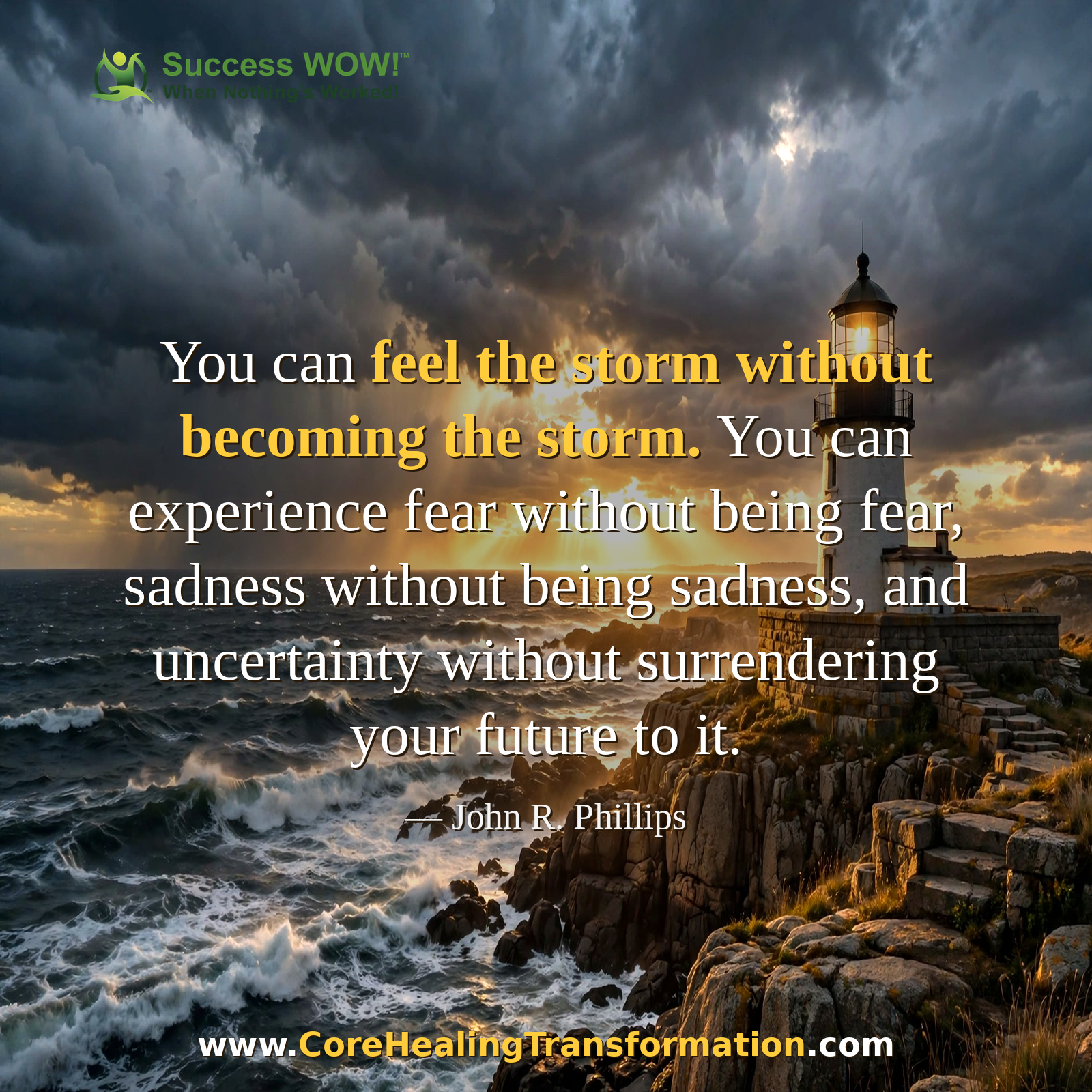
“You can feel the storm without becoming the storm. You can experience fear without being fear, sadness without being sadness, and uncertainty without surrendering your future to it.” — one of my Friday quotes, and the whole method in a sentence.
1. Fear
Fear feels like a tightening — chest, throat, stomach. Your mind starts fast-forwarding to worst cases. It’s your system trying to protect you, and it deserves a thanks, not an argument.
Tip: Name it out loud if you can. “There’s fear about this meeting.” Then ask it one question: “What do you need me to know?” Fear with a job is an advisor. Fear without one is just noise.
2. Anger
Anger feels hot — jaw, fists, a surge behind the eyes. It means a boundary got crossed, real or perceived. There’s nothing wrong with anger itself; it’s information, and useful information at that.
Tip: Don’t act on it in the first ninety seconds. Breathe, unclench your jaw, drop your shoulders. Then decide: is there a real boundary to address? If yes, address it calmly. If no, release it — it was just old fuel.
3. Sadness
Sadness feels heavy — like gravity turned up a notch. Eyes sting, energy drops, everything slows. Sadness usually means something mattered to you. That’s not weakness; that’s being human.
Tip: Give it a time-boxed welcome instead of a whole day. Sit with it for ten minutes — really feel it — instead of scrolling past it for ten hours. Welcomed sadness moves through. Dodged sadness camps out.
4. Shame
Shame whispers that something is wrong with you — not what you did, but who you are. It makes you want to hide. Everybody feels it, and almost nobody talks about it, which is exactly why it thrives.
Tip: Say it to a safe person, or write it down exactly as it sounds in your head. Shame can’t survive being seen. The moment it’s spoken, it shrinks from a life sentence back down to a feeling.
5. Guilt
Guilt is regret with an edge — the replay of what you did or didn’t do. A little guilt is a good sign: it means your conscience works. But guilt has an expiration date, and most people never let it expire.
Tip: If you can make it right, make it right — apologize, fix it, learn from it. If you can’t (or already did), the guilt has finished its job. Thank it, release it, and let the lesson live on without the punishment.
6. Anxiety
Anxiety is fear about the future wearing a disguise. It feels like static — restless body, racing thoughts, a sense that something is wrong but you can’t find it. It’s exhausting because it never resolves; the future never arrives in the form you’re bracing for.
Tip: Come back to right now. Feel your feet on the floor, name five things you can see, take one slow breath. Anxiety lives in “what if.” You live in “what is.” They’re never in the same place.
7. Jealousy
Jealousy stings because it points at something you want. Someone has it, you don’t, and your mind turns that into a story about what’s missing in you. It’s an uncomfortable feeling, but it’s actually a compass — it’s showing you what you value.
Tip: Get honest about what the jealousy is really pointing to. Not the person — the thing underneath. Then ask: “What’s one small step I can take toward that for myself?” Turn the envy into a to-do list and the charge drops fast.
8. Loneliness
Loneliness isn’t about being alone — plenty of people feel lonely in a crowded room. It’s the sense of being unseen, disconnected, on the outside of something. It hurts because connection is a genuine human need, not a luxury.
Tip: Take one small reaching-out action today. Text one person. Smile at one stranger. Show up somewhere for ten minutes. Loneliness tells you connection is impossible; it’s lying. One small bridge at a time.
9. Overwhelm
Overwhelm feels like too much, too fast — a pile with no bottom and no top. Everything feels urgent, so nothing gets done, which makes everything feel more urgent. It’s a loop, and loops need interrupting.
Tip: Write it all down — get the whole storm out of your head and onto paper. Then pick ONE thing. Just one. Do it. Overwhelm feeds on vagueness; specificity starves it.
10. Grief
Grief is love with nowhere to go. It comes in waves — some days fine, some days flattened by a song, a smell, a memory. There’s no schedule for it, no “should be over by now,” no doing it wrong.
Tip: Stop trying to get over it and let yourself go through it. When a wave hits, breathe and ride it — waves crest and pass. And when the wave recedes, do one thing that honors what (or who) the love was for. Grief is proof the love was real.
Bonus: Boredom
Boredom doesn’t feel dramatic — that’s why it’s so easy to miss. It feels like restlessness, like nothing sounds good, like scrolling, snacking, or reaching for something just to fill the space. But boredom has a message too: you’re not being challenged, and some part of you is hungry for growth.
Tip: Don’t feed boredom — answer it. Ask: “What’s one thing that would actually interest me right now?” Then do that thing for ten minutes. Boredom isn’t a sign that nothing matters; it’s a sign that something in you wants to grow. And if boredom is the feeling that sends you to the pantry, that’s the pattern talking, not hunger — I wrote about that one here: How Hypnosis Helps You Lose Weight (Without Another Diet).
Your Quick-Reference Map

When you’re in the middle of a feeling, you don’t want a lecture — you want the short version. Here it is:
| Emotion | Body signal | The tip in one line |
|---|---|---|
| Fear | Tight chest, throat, stomach; worst cases on fast-forward | Name it out loud, then ask: “What do you need me to know?” |
| Anger | Heat — jaw, fists, a surge behind the eyes | Wait ninety seconds, unclench, then decide if a real boundary needs addressing |
| Sadness | Heaviness, stinging eyes, low energy | Time-box it: ten real minutes instead of ten distracted hours |
| Shame | Urge to hide; “something is wrong with me” | Say it to a safe person or write it down — shame shrinks when seen |
| Guilt | The replay loop of what you did or didn’t do | Make it right if you can; if you already did, thank it and release it |
| Anxiety | Static — restless body, racing thoughts | Come back to right now: feet on the floor, five things you can see, one slow breath |
| Jealousy | A sting; the story of what’s missing in you | Find what it’s pointing to, then take one small step toward it yourself |
| Loneliness | The sense of being unseen, on the outside | One small reaching-out action today |
| Overwhelm | Too much, too fast; everything urgent | Write it all down, then pick ONE thing |
| Grief | Waves — fine one day, flattened the next | Ride the wave; then do one thing that honors the love |
| Boredom (bonus) | Restlessness; nothing sounds good; reaching for a distraction | Don’t feed it — answer it: do one interesting thing for ten minutes |
Keep this table somewhere handy. In the moment, you don’t need to remember the whole article — you need one row.
Three Moments to Picture
These are illustrations — made-up scenes to show the steps in action, not stories from real clients.
Imagine you’re about to walk into a performance review. Your chest is tight, your mind is already rehearsing the worst version. Notice: “There’s fear about being judged.” Welcome: you don’t argue with it, you don’t replay the review ten times — you just let the tightness be there. Release: one slow exhale, a scan of your shoulders, a quiet “I let this go.” You walk in with the fear still in the room — but you’re the one walking in, not the fear.
Imagine the drive home after a tense call with your mother. Your jaw is clenched, and the argument is still playing in your head — the things you should have said. Notice: “There’s anger, and there’s shame underneath it.” Welcome: no fixing, no replaying, just feeling the heat for what it is. Release: unclench your jaw, drop your shoulders at the next red light, one long breath out. By the time you pull into the driveway, the argument has lost its grip — because you stopped feeding it.
Imagine a Sunday evening, the week ahead looming. Everything feels urgent, so you do nothing, which makes everything feel more urgent. Notice: “There’s overwhelm.” Welcome: it’s here, and it’s allowed to be here. Release: you write the whole storm onto paper, and then you pick ONE thing — just one — and do it. The pile is still there. But it’s no longer a fog; it’s a list. And a list can be worked.
That’s the practice. Not perfect. Just practiced.
The Pattern Behind All Ten
Did you catch it? Same three steps every time:
Notice it early — name it before it names you. Welcome it — drop the fight, drop the story, just let it be there. Release it — breathe, feel where it lives in your body, and let it go.
You don’t need to master this. You just need to practice it. The first few times it feels clumsy, like learning to ride a bike. Then one day you catch the anger at step one instead of step explosion, and you realize something shifted.
And here’s the deeper truth: most of these emotional patterns aren’t choices. They’re subconscious programs — old recordings playing on autopilot, installed years ago by experiences you may not even remember. That’s why willpower alone often doesn’t cut it, and it’s also why hypnosis works so well for this: it speaks the language of the subconscious, where the pattern actually lives. You don’t have to fight the recording. You can re-record it.
In my own work, I call that process the Toxic Pattern Vanisher™ — finding the old pattern underneath the emotion and dissolving it at the root, so the feeling stops recycling itself. But whether or not we ever work together, these three steps are yours. Use them today.
Try It Tonight

Right now, whatever you’re feeling — even a low hum of it — run the three steps. Notice: “There’s ______.” Welcome: “It’s okay that this is here.” Release: one slow exhale, one scan of your body, one quiet “I let this go.”
That’s the whole practice. Three steps. Any emotion. Any day.
Questions People Ask
What if I can’t name what I’m feeling?
Start with the body — it names the feeling before the mind does. Tight, heavy, hot, restless: “There’s something tight here” counts as noticing. The name can come later. The noticing is the step.
Isn’t welcoming an emotion the same as wallowing in it?
No — welcoming is letting it be there without fighting it or feeding it. Wallowing is feeding it: replaying the story for the hundredth time. Welcome is the middle path. The feeling is there either way; the question is whether you’re wrestling it or letting it pass through.
How long does release take?
Sometimes one breath. Sometimes the same feeling needs welcoming ten times in a day. That’s not failure — that’s practice. The pattern loosens a little each time you don’t fight it.
When is it time to get help?
When the same emotion keeps recycling no matter what you try — the same fear, the same anger, the same sadness on repeat. That’s usually a sign it’s rooted deeper than conscious effort can reach. That’s what the deeper work is for, and that’s what I help people with.
I offer a complimentary 30-minute Zoom strategy session — we just see if what I do can help. Text me at (801) 638-4413. If it’s a fit, we’ll know. If it’s not, you’ll still leave with something useful.
You’ve got this. One emotion, three steps, at a time.
Keep Reading
- How Hypnosis Helps Anxiety Vanish at the Root
- How Hypnosis Can Skyrocket Your Confidence and Self-Esteem
- How Hypnosis Helps You Lose Weight (Without Another Diet)
- Stop Smoking Hypnosis: The Definitive Guide to Quitting Nicotine Fast
- How to Achieve Your Own Core Healing
- What Is Hypnosis And How Can It Help You In Your Life?
- How to Kill Your Sugar Cravings Using Hypnosis
- What if freedom from 100% of your stress can be achieved by letting go?
- Is Hypnosis for Children?
- Procrastination solved with hypnosis
- Eliminating Bad Habits with Hypnosis Fast
- Is Hypnosis Science Based?
