
How Hypnosis Helps Anxiety Vanish at the Root

It’s 3am. You’re awake, staring at the ceiling, and the worry machine is running again. The conversation from yesterday, replayed — did I say the wrong thing? The meeting tomorrow, rehearsed — what if they ask me something I can’t answer? The money, the health thing, the future that never quite feels safe enough to rest in. The thoughts loop. Your chest is tight. Your jaw is clenched. And the worst part is, you know the worrying isn’t helping — and it just won’t stop.
Here’s what nobody tells you about anxiety: it isn’t a character flaw, it isn’t weakness, and it isn’t who you are. It’s a pattern — an old alarm system installed long ago that never got the message the danger passed.
That alarm was useful once — it kept you alert, careful, prepared. But somewhere along the way it stopped being a smoke detector and became a fire alarm that goes off every time someone makes toast. And the more you fight it, the louder it gets. Fighting anxiety is like wrestling a shadow — the struggle itself is what keeps it alive.
There’s another way. Not fighting the pattern. Understanding it — and then letting it dissolve at the root.
Why Anxiety Persists — and Why Fighting It Makes It Stronger
Think of your mind like a thermostat. Your conscious mind sets the temperature — “I’m going to stop worrying, I’m going to relax, I’m going to be fine.” But the thermostat itself, the setting the house actually runs at, lives in the subconscious. And that setting was programmed years ago, mostly without your permission.
A childhood where you had to stay alert to stay safe. A season where thinking through every outcome was the only way to feel in control. A loss, a scare, a period when vigilance was the price of getting through. Each experience wrote a line of code: Stay alert. Expect the worst. If you worry enough, you’ll be ready.
By adulthood, those lines run automatically. You’re not choosing to lie awake at 3am running disaster scenarios. The program is choosing for you. Willpower tries to override the program. Positive thinking tries to argue with it. Breathing apps try to soothe it. But none of them can rewrite it — because the program doesn’t live on the floor where willpower works. It lives below.
And fighting it makes it worse. Anxiety is, at its core, a message from your nervous system that says something is wrong. Fight the feeling and the system sends the message louder. Brace against it and your body reads the bracing as confirmation: see, there really is danger here. The struggle becomes the evidence. That’s why the people who fight anxiety hardest often feel it strongest — not because they’re doing it wrong, but because fighting was never the way out.
What if the way out is understanding — seeing the pattern clearly enough that it finally loosens its grip?

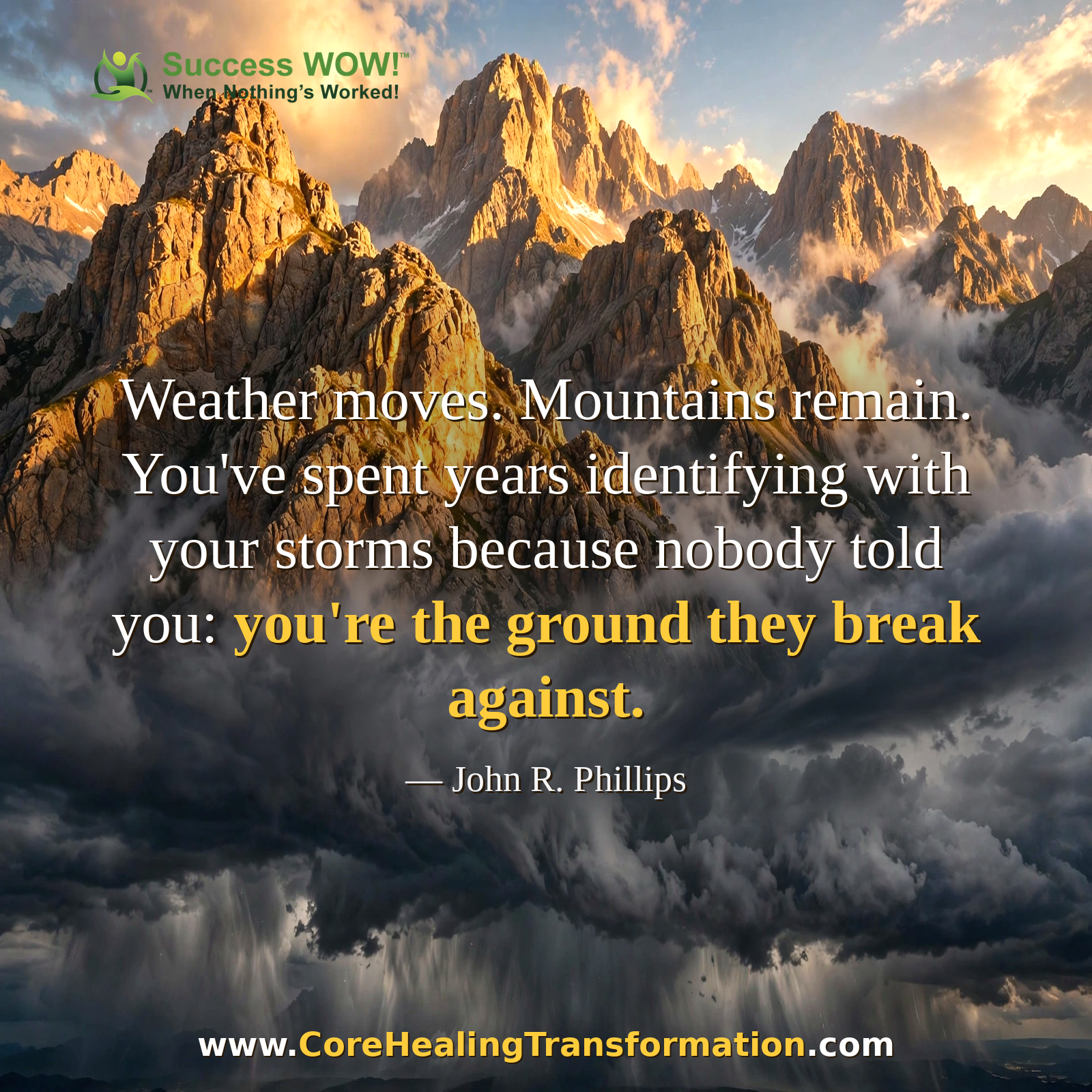
“Weather moves. Mountains remain. You’ve spent years identifying with your storms because nobody told you: you’re the ground they break against.” — one of my Friday quotes, and the truest thing I know about anxiety.
How Hypnosis Works on Anxiety
Hypnosis isn’t what movies made you think. You’re not asleep, you’re not unconscious, and nobody’s controlling you. You’re deeply relaxed and highly focused — like that state right before you drift off to sleep, where you’re still aware but the chatter quiets down. In that state, the door between the conscious decision and the subconscious program opens. And that’s where the real work happens.
Here are the mechanisms that actually change things:
1. It finds the root — the moment the alarm was installed. In a relaxed, focused state, your mind can trace a current anxiety back to where it started. Not in a dramatic, must-relive-the-trauma way — more like following a thread. “When did you first feel this way?” And up comes the memory: the house where you had to be careful, the classroom where being wrong was dangerous, the season when the ground shifted under you. Awareness alone loosens the pattern’s grip, because a pattern can’t run invisibly once it’s been seen. In my work I call the whole process the Core Healing Transformation™ — and when the roots go deep, we go with them, returning through age regression to where the pattern was installed and transforming it at the source. I’m not a licensed therapist, so if you’re dealing with an active mental-health condition, a therapist is the right call and I’ll say so. But the patterns underneath the anxiety — the old alarm, the vigilance, the recordings that say stay ready or else — that’s exactly what this work transforms.
2. It dissolves the pattern instead of fighting it. This is the one people notice first. In a relaxed, focused state, we find the old recording underneath the worry — if I stop worrying, something bad will happen — and we dissolve it. Not by arguing with it. By letting the deeper part of your mind finally let it go. I call that process the Toxic Pattern Vanisher™ — finding the old pattern underneath the anxiety and dissolving it at the root, so the worry loop stops recycling itself. Clients describe it the same way, over and over: the thoughts stop arriving uninvited. The alarm is still there — it just stopped going off every time someone makes toast.
3. It calms the nervous system directly. Anxiety lives in the body as much as in the mind — the tight chest, the shallow breathing, the jaw, the stomach. Hypnosis works on the body first: slow breathing, relaxed muscles, lower internal volume. A calm nervous system stops reading ordinary life as a threat. Sleep deepens. The 3am wake-ups get rarer, then stop. And here’s the present-moment truth: peace isn’t about the future working out. It’s about being okay right now — and when your system settles into right now, the future stops needing to be solved in advance. Anxiety is a feeling with a message underneath it — I break down what each emotion is actually telling you in How to Handle 10 Emotions in Three Easy Steps. And once the message is heard, the feeling can finally let go.

4. It rehearses calm instead of disaster. Your nervous system doesn’t know the difference between a vivid rehearsal and a real experience — which is exactly why anxiety rehearses disaster so effectively. Every time you run the worst case in your head, your body logs it as evidence. Hypnosis turns that mechanism around. In a relaxed, focused state, we walk through the real upcoming situations and rehearse them going well. Not perfectly. Well. The subconscious accepts what’s believable, and believable is enough to change behavior. By the time the moment arrives, your nervous system has already done it calmly a dozen times — and calm, rehearsed often enough, becomes the new default.
What a Session Actually Feels Like

People are usually surprised by how ordinary it feels — in the best way.
You sit in a comfortable chair, fully clothed, eyes closed. I talk you through a relaxation process — nothing strange, just guided breathing and focusing your attention inward. Within minutes, most people feel heavy and light at the same time: body sinking, mind clear. You can hear everything I say. You could open your eyes and get up at any point. Many people tell me afterward it felt like the best nap they never quite took.
Then we do the work — the finding, the dissolving, the re-recording. You’ll be aware of it happening; clients often describe it as watching an old fear lose its charge in real time, like a radio station fading as you drive away. There’s no dredging up of things you can’t handle. Your subconscious is protective; it shows you what you’re ready to see.
When you come back up, the room looks the same. But something internal has shifted. People notice it in small moments first: the email that used to spike your heart rate, and this time it doesn’t. The drive home without the replay of the day. Catching the worry loop mid-sentence — and finding it kind of funny.
Try This Today: Three Practical Takeaways
You don’t have to wait for a session to start shifting things. Here’s what actually works:
1. Name the storm instead of becoming it. When the worry starts, don’t fight it and don’t obey it. Just notice it the way you’d notice weather: “There’s the storm again.” Naming it as weather, not the truth, breaks its authority. You are not the storm — you’re the ground it moves across, and ground doesn’t have to do anything about weather. It just lets it pass.
2. Ask what the feeling is trying to tell you. Anxiety is a messenger, not a malfunction. Underneath the worry there’s almost always a real need: rest, safety, a boundary, a decision you’ve been putting off. Pause for sixty seconds. Three slow breaths. Then ask: “What am I actually needing right now?” Half the time, the answer is simple — sleep, a walk, a conversation, a no. And when you give yourself the real thing, the alarm loses its job.
3. Rehearse the calm version for sixty seconds. Close your eyes. Picture yourself in tomorrow’s worrying situation and see yourself handling it well. Not perfectly. Well. Feel it in your body: shoulders down, breathing easy, present. Hold it for a minute. You’re doing in miniature what hypnosis does in depth — giving the nervous system a rehearsal of calm instead of another rehearsal of disaster.
Picture the Shift
Three short scenes to show what the change actually looks like. These are illustrations — made-up moments, not stories from real clients.
Imagine it’s 3am, and you’re awake. The worry machine is already running. This time, you notice it as weather, not truth — “there’s the storm again” — and you don’t climb into it. Three breaths. “What am I actually needing?” Rest — you’re exhausted, not in danger. You roll over, and sleep comes. And the next night, the storm is quieter.
Imagine the meeting where you usually brace. The what-ifs stack up on the drive over — what if they ask something you can’t answer, what if I sound foolish. This time, you’ve already rehearsed it calm a dozen times in your mind. You walk in, and the alarm doesn’t go off. You answer what’s asked. The meeting ends, and you realize you were actually there for it — instead of stuck in the rehearsal of it.
Imagine a Sunday evening, and the dread used to start right on schedule — the whole week ahead, already heavy. This time, you notice the dread as a pattern, not a forecast — “there’s that old recording again” — and you let it pass like weather. You make tea. You plan one good thing for Monday. The week hasn’t happened yet, and for the first time in a long time, you don’t need it solved before you can rest.
That’s what the shift looks like. Not a new personality. Just you, with the alarm turned down to the volume it was always meant to be — and your nervous system finally free to rest.

The Deeper Invitation
Here’s the framework this whole work rests on — the whole emphasis of what I do:
“Awareness reveals the chains. Understanding shows you why you wear them. Healing gives you the courage to loosen them. Transformation reminds you that you were always more than the chains.”
Anxiety is a chain you were never meant to keep wearing. It was installed to protect you — but protection that never switches off stops being protection. Awareness shows you the chain. Understanding shows you why it’s there. Healing gives you the courage to loosen it. And transformation reminds you of the truth underneath all of it: you were always more than the worry. You were always the ground, not the storm.
If there’s a pattern that keeps running no matter what you try — the same worry loop, the same 3am wake-ups, the same bracing on repeat — that’s a sign it’s rooted deeper than conscious effort can reach. That’s exactly what I help people with.
Questions People Ask
Will hypnosis make me do or say things I don’t want to?
No. You’re aware the whole time — you can open your eyes and stop at any point. Hypnosis is focused relaxation, not control. Nothing happens that you don’t agree to.
I’ve tried breathing exercises and meditation. Why would this be different?
Breathing and meditation work on the feeling in the moment — and they’re genuinely useful. But they don’t reach the program underneath that keeps generating it. Hypnosis works where the program lives — below, in the subconscious. That’s the difference. You’re not managing the alarm; you’re finding out why it was installed and dissolving it at the root.
How many sessions does anxiety take?
It varies, and I’ll be straight with you about that. Some patterns loosen fast; some are layered. The strategy session is where we look at your specific pattern and talk honestly about what it would take.
Is anxiety really a hypnosis thing — or do I need therapy?
The roots of anxiety often are trauma — and I do work with those roots. Through age regression in the Core Healing Transformation, we go back to where the pattern started and transform it at the source. I’ve had EMDR therapists tell me they didn’t get their own core healing until going through this program. I’m not a licensed therapist, so if you’re dealing with an active mental-health condition, a therapist is the right call and I’ll say so. But for the learned patterns underneath — the old alarm, the worry loop, the vigilance that never switches off — that’s exactly what this work does.
Does hypnosis work online?
Yes. Once your eyes are closed, the process is identical — and the change is anchored in your own environment, where the patterns actually live. That’s why it often works even more successfully online. All my sessions are available by Zoom.
I offer a complimentary 30-minute Zoom strategy session — we just see if what I do can help. Text me at (801) 638-4413. If it’s a fit, we’ll know. If it’s not, you’ll still leave with something useful.
With 83 five-star Google reviews from people who walked in feeling the way you feel now: the calm version of you isn’t some stranger you have to become. It’s you, underneath the recordings. Let’s find them.
You’ve got this. One pattern, one storm, at a time.
Keep Reading
- How to Handle 10 Emotions in Three Easy Steps
- How Hypnosis Can Skyrocket Your Confidence and Self-Esteem
- How to Kill Your Sugar Cravings Using Hypnosis
- How Hypnosis Helps You Lose Weight (Without Another Diet)
- Stop Smoking Hypnosis: The Definitive Guide to Quitting Nicotine Fast
- How to Achieve Your Own Core Healing
- What Is Hypnosis And How Can It Help You In Your Life?
- What if freedom from 100% of your stress can be achieved by letting go?
- Is Hypnosis for Children?
- Procrastination solved with hypnosis
- Eliminating Bad Habits with Hypnosis Fast
- Is Hypnosis Science Based?
